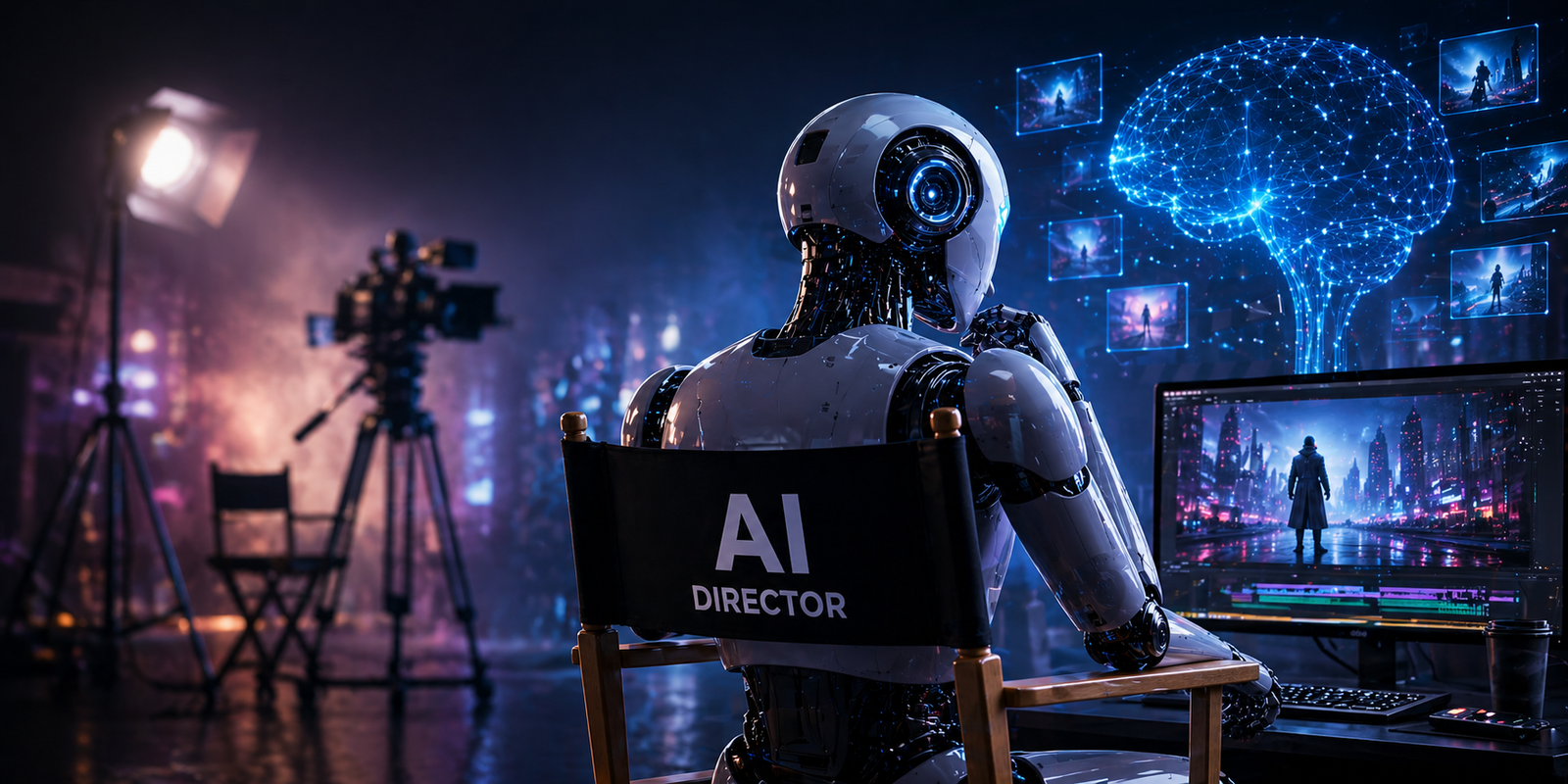
For decades, storytelling in media and entertainment has been shaped by human imagination—directors, writers, editors, and producers working together to bring ideas to life. But that equation is changing fast. Artificial intelligence isn’t just a supporting tool anymore. It’s stepping into the director’s chair—guiding narratives, shaping visuals, and even predicting what audiences want before they press play.
This isn’t science fiction. It’s already happening.
🎬 The Shift: From Creative Control to Creative Collaboration
AI isn’t here to replace storytellers—it’s here to amplify them. Traditionally, storytelling was a linear process:
Idea → Script → Production → Editing → Release
Now, AI compresses and enhances every stage:
- Scripts can be generated, refined, and localized instantly
- Visual scenes can be pre-visualized without expensive shoots
- Editing decisions can be optimized in real-time
- Audience feedback can shape content even before release
What used to take months can now happen in days or even hours. The result? Faster storytelling, smarter decisions, and more room for experimentation.
🧠 AI as the Brain Behind the Story
AI’s biggest strength is not creativity it’s pattern recognition.
It studies:
- What audiences watch
- When they drop off
- Which characters they connect with
- What endings perform better
This allows creators to build stories that are not just artistic, but strategically engaging.
Think about it:
- Plot twists that are timed perfectly
- Characters designed to resonate with specific audiences
- Narratives that adapt based on viewer behavior
This is storytelling backed by data—not guesswork.
🎥 From Script to Screen Faster Than Ever
AI tools are already transforming production workflows:
- Scriptwriting: AI can generate story ideas, dialogues, and even entire scripts
- Pre-visualization: Directors can see scenes before they’re shot
- Editing: AI identifies the best takes, cuts scenes, and enhances pacing
- Voice & Performance: Synthetic voices and digital actors are becoming indistinguishable from real ones
This doesn’t just save time—it lowers the barrier to entry. Now, a small team (or even a single creator) can produce content that looks and feels studio-level.
🎭 The Rise of Adaptive Storytelling
Here’s where things get interesting. AI is turning storytelling from a passive experience into an interactive one.
- Stories that change based on viewer choices
- Multiple endings tailored to audience preferences
- Real-time narrative adjustments
We’re moving toward a world where no two people experience the same story in the same way. Entertainment becomes personal.
📊 Data is the New Script Supervisor
In traditional filmmaking, decisions were often driven by instinct.
Now, data plays a central role:
- Which genre is trending
- What length performs best
- Which emotions drive engagement
AI doesn’t replace creative instinct but it sharpens it.
It answers questions like:
- Will this scene hold attention?
- Is this character arc compelling enough?
- Where will viewers lose interest?
That’s powerful.
⚖️ The Creative Tension: Art vs Algorithm
Let’s be real this shift isn’t without friction.
There are big questions:
- Will AI make stories feel formulaic?
- Are we sacrificing originality for optimization?
- Who owns AI-generated content?
And the biggest one:
Can a machine truly understand human emotion? Right now, AI can mimic emotion but it still relies on human input for depth, nuance, and meaning.
The best results don’t come from AI alone. They come from humans using AI intelligently.
🚀 What This Means for the Future of Entertainment
We’re entering a new era where:
- Creators become directors + technologists
- Stories become dynamic, not fixed
- Content becomes scalable without losing quality
- Audiences become participants, not just viewers
The gap between imagination and execution is shrinking. And that’s a big deal.
🌐 The Kulutre Labs Perspective
At Kulutre Labs, this shift isn’t just observed it’s embraced. The future of media lies at the intersection of: Culture + Creativity + Intelligence
AI gives us the power to:
- Tell richer stories
- Reach wider audiences
- Experiment without limits
But the goal isn’t to let AI take over storytelling. The goal is to make storytelling more alive.
💭 Final Thought
AI is not replacing directors. It’s redefining what it means to be one. The storytellers who win in this new era won’t be the ones who resist AI they’ll be the ones who learn how to direct with it. Because in the end, technology doesn’t tell stories. People do. AI just makes those stories impossible to ignore.